Independently Owned, Locally Grown, Community Loved

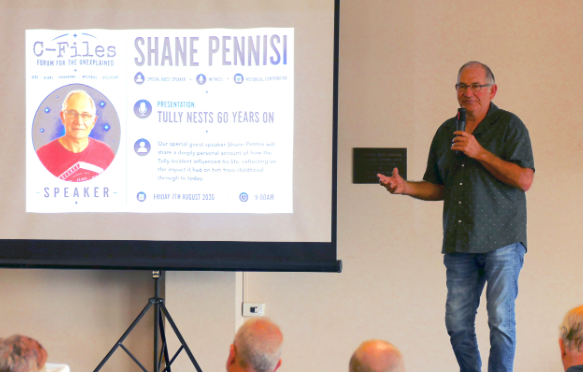
Shane Pennisi speaking about the Tully Nests at the C-Files Forum, at the Australian UFO Festival in Cardwell, 2026. Photo credit: Victoria Velton
By Victoria Velton
For decades, Shane Pennisi has carried the story of the strange formations found on his family’s property at Euramo. This year’s Australian UFO Festival marked the final time he would share that story from the stage.
Speaking at the C-Files Forum, Shane presented his experiences of the Tully Nests phenomenon, which has remained connected to his family and their farm for generations.
He described the presentation as his “first and last hurrah,” with the family property now set to be sold and his connection to the farm coming to an end.
“That’s going to be it, because once the farm is sold, I’ll be moving away from here, and that’ll be it for any family attachment to the farm,” Shane said.
The story began with Shane’s father, George, who was the first to find circular formations of flattened reeds in the farm’s lagoons. George would regularly check the lagoons for the markings, and Shane continued the practice, eventually documenting and investigating the formations himself.
They came to suspect the formations to be a possible sign of extraterrestrial life; landing sites for circular crafts unlike any in known use by humans.
“I stopped counting, but there were over 40, at least over 40,” Shane said.
The family entered some of the larger formations and collected soil and water samples for testing. At the time, radioactive testing produced no significant results, while other testing also failed to identify chemicals or other obvious explanations for what had occurred.
One observation, however, stayed with Shane.
“There was an incident where the grass reeds reshot because of moisture, when they were supposed to be dead,” he said.
The surrounding environment appeared largely unaffected by the formations. Wildlife and birdlife continued as normal, while the trees and vegetation did not show the sort of damage Shane might have expected from an unexplained event.
It is one of the reasons he remains fascinated by the possibility that whatever created the formations may have understood the environment in ways humans do not.
“I reckon they could teach us a thing or two about environment and protecting it, and living with it,” he said.
Shane believes the location of the farm could also be significant. He recalled research suggesting the property sits along a magnetic grid line, with other locations above and below it also falling along the same alignment.
The idea, he suggested, was that such lines could potentially be used to assist with a craft’s movement, take-off or landing. But despite his decades of involvement with the phenomenon, Shane has never claimed to know exactly what created the formations.
“I can prove nothing, but I’m just telling you what I saw and what I’ve experienced,” he said.
While UFO stories often feature fear, abduction and hostility, Shane’s own experience has been far less dramatic. His encounters just left him with questions.
“I just would like to know what they’re like, how they do it,” he said, musing on what he’d do if he ever had the chance to meet the suspected extraterrestrials.
Shane wonders whether an advanced civilisation might have something to teach humanity. He believes that if we did have visitors to the planet, they would be technologically and intellectually far ahead of humans; so perhaps they would have solutions to problems that continue to plague Earth.
That question became one of the most personal reflections of Shane’s presentation.
“Are they advanced with their minds? You know, the way they live with each other?” he wondered.
“I do believe Stan Sears was onto something when he said they (the extraterrestrial visitors) were checking out and seeing how we’re treating the planet,” Shane said.
“And I do believe we’re failing very dismally.”
After decades of looking into the Tully Nests, Shane’s final presentation was about more than investigating the strange markings in a North Queensland lagoon.
It asked what might exist beyond Earth, what those beings might know, and whether humanity would be ready to listen. For Shane, the answer is yes.
“I think the world is ready for new neighbours,” he said.
“We’re ready to find out what’s beyond the stars.”
Publishers Indemnity. Any individual or entity that places advertising, supplies copy material, or submits editorial content to Life Publishing agrees and undertakes to ensure that all such material:- Does not infringe upon any copyright, trademark, or other intellectual property rights;- Is free from any content that could be considered defamatory, libelous, or slanderous;- Does not infringe upon any rights related to privacy or breach of confidence;- Contains no obscene, indecent, or otherwise unlawful material;- Complies fully with the Trade Practices Act and all other applicable laws, regulations, or statutes. Furthermore, by submitting or placing such material, these individuals or entities agree to indemnify and hold harmless the publisher, Life Publishing and Events Pty Ltd, and/or its agents from and against any and all investigations, claims, demands, liabilities, damages, costs, or judgments arising out of or in connection with the material provided. All material is believed to be accurate at the time of printing and remains the copyright of Life Publishing and Events Pty Ltd.
© 2026 Life Publishing Group Ltd.