Independently Owned, Locally Grown, Community Loved

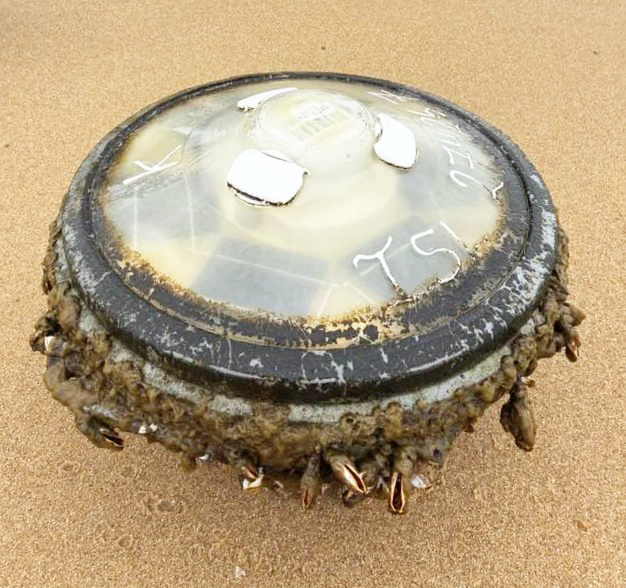
A mysterious barnacle-covered object bearing the identification number ISL+274267 washed ashore at the southern end of Wongaling Beach. Photo credit: Linden Carney
A strange barnacle-covered object discovered on the southern end of Wongaling Beach has sparked plenty of curiosity among locals, with the mystery item believed to be part of a device used by commercial fishing vessels to locate fish at sea.
Mission Beach’s Linden Carney who came across the circular object shared photographs online asking if anyone knew what it could be, prompting several suggestions however, its appearance and identification markings suggest it may be a satellite tracking buoy associated with a drifting Fish Aggregating Device, commonly known as a FAD.
Photographs show the identification number ISL+274267 on the object, although exactly where it came from, who owns it and how far it travelled before reaching Wongaling Beach remain a mystery.
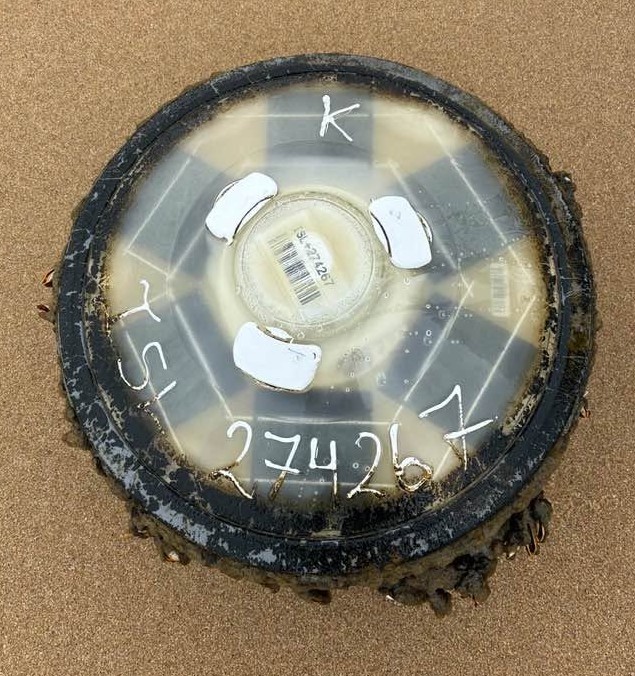
FADs are used by commercial fishing vessels to help locate fish such as tuna, which naturally gather around floating objects in the ocean. Drifting versions can be fitted with satellite tracking equipment and, in some cases, sonar, allowing fishing crews to follow the device and detect fish gathering beneath it.
Judging by the marine growth covering the Wongaling Beach find, the unusual object certainly appears to have spent some time at sea before its arrival on the Cassowary Coast, and it’s not the first mysterious object to turn up on a nearby North Queensland beach in recent months.
In early July, six large spherical metal objects washed ashore at Forrest Beach, near Ingham, attracting national and international attention. Authorities established a safety exclusion zone while the objects were investigated, with the Australian Space Agency later saying they appeared consistent with pressure vessels from a space launch vehicle.
While the Wongaling Beach discovery appears to have a much more earthly explanation, it has once again sparked plenty of curiosity about what can travel across the ocean before eventually finding its way onto Far North Queensland's shores.
Publishers Indemnity. Any individual or entity that places advertising, supplies copy material, or submits editorial content to Life Publishing agrees and undertakes to ensure that all such material:- Does not infringe upon any copyright, trademark, or other intellectual property rights;- Is free from any content that could be considered defamatory, libelous, or slanderous;- Does not infringe upon any rights related to privacy or breach of confidence;- Contains no obscene, indecent, or otherwise unlawful material;- Complies fully with the Trade Practices Act and all other applicable laws, regulations, or statutes. Furthermore, by submitting or placing such material, these individuals or entities agree to indemnify and hold harmless the publisher, Life Publishing and Events Pty Ltd, and/or its agents from and against any and all investigations, claims, demands, liabilities, damages, costs, or judgments arising out of or in connection with the material provided. All material is believed to be accurate at the time of printing and remains the copyright of Life Publishing and Events Pty Ltd.
© 2026 Life Publishing Group Ltd.