Independently Owned, Locally Grown, Community Loved

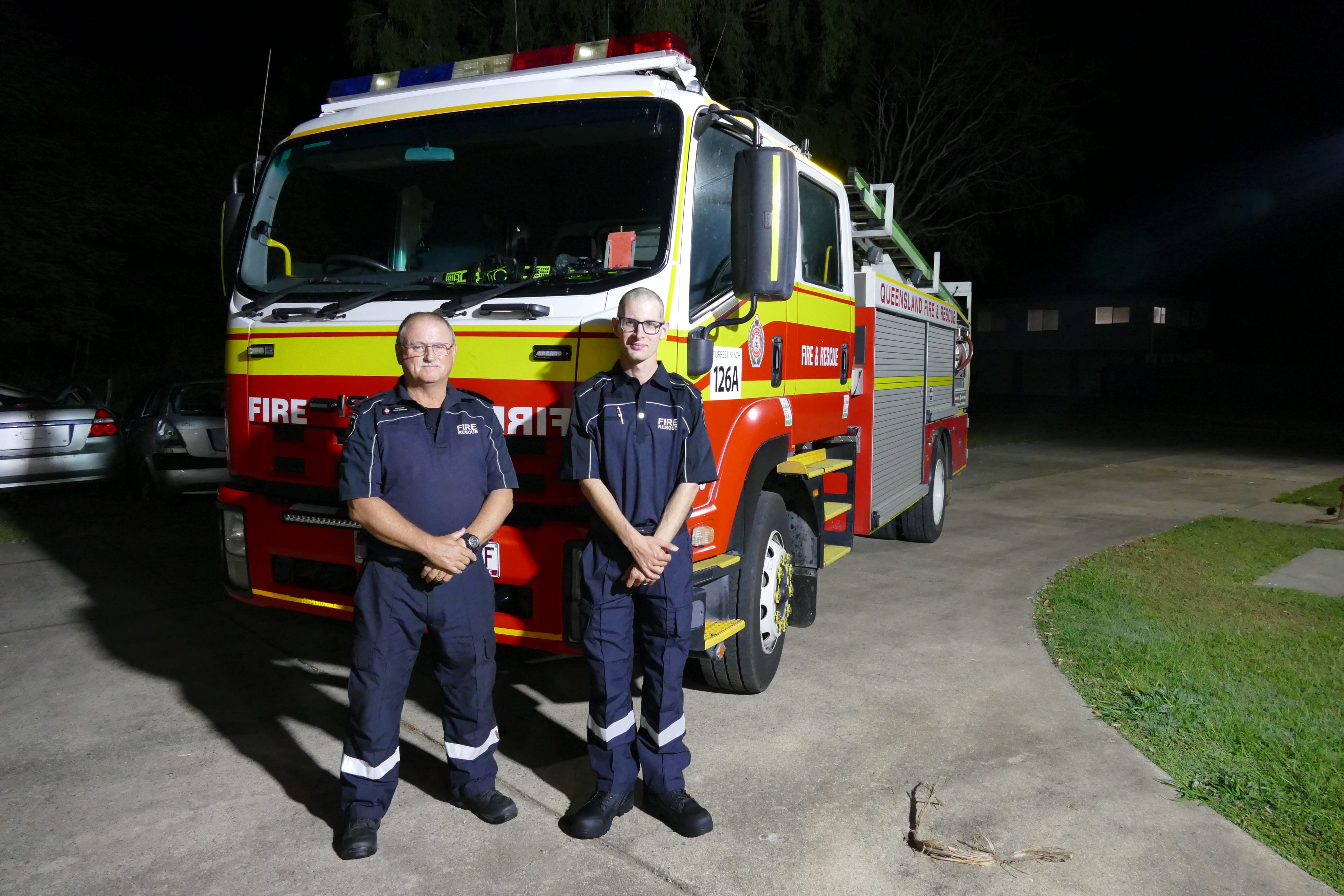
Members of the Forrest Beach Auxiliary Firefighters: Glyn Morgan, former Air Force serviceman, and Braydon Fratus, local mill worker and the brigade's newest recruit, standing by the Forrest Beach Brigade’s fire engine.
The People Behind The Uniform: Forrest Beach Auxiliary Firefighters
When disaster strikes, firefighters are often the first people the community turns to. But behind every emergency response is a team of locals who give their time, train regularly and step up when their neighbours need them most.
Forrest Beach Fire and Rescue is encouraging more community members, particularly younger residents, to consider joining the station and becoming part of the team.
"It's a good thing to get people back in from the community, especially for the station here; because we're an elderly community. Getting the younger people in is really, really important,” said Acting Lieutenant Keith Amos.
Keith highlighted that being part of the station is a chance to make a tangible impact on the community- and not just in cases of fire.
During the major flooding event of 2025 that isolated Forrest Beach and surrounding areas, firefighters assisted residents, with rescues, but also delivering meals and helping secure damaged homes.
"The floods, when we were cut off, the way we were seen by the community and how we helped people really made an impact," Keith said.
The crew’s role is diverse, and potential recruits are reminded that it’s not all flashing lights and sirens.
Beyond the emergencies, auxiliary firefighters have an important role in the everyday community; regularly attending markets, school safety days and events to teach fire safety and engage with local families.
During the recent Tasman Turtle Picnic Day, a popular community event for children, countless young attendees were proudly sporting the station’s bright, colourful Blazer the Koala firefighting mascot stickers.
"We try and get into the community, showing what we do," Auxiliary Firefighter Michael Monbelli said.
Michael also explained that for him, the biggest obstacle is balancing service with everyday life – though this factor he feels is understood and well-supported by the crew.
Michael balances his firefighting role with full time work at the mill, and a busy family life with young children. On his team, there is a schoolteacher, two ex-servicemen, and another millworker.
Auxiliary firefighters also commit significant time to weekly training. As for emergency response, call-outs can occur at any hour of the day or night.
"Being an auxiliary is that we're on call.” Acting Lieutenant Keith Amos explained.
“So even on our Wednesday night training we can get a call."
Keith described the role as ‘drop everything and jump into action’.
Despite the demands, Former Army serviceman Mark McEwen believes many people underestimate how manageable the role can be.
"It doesn't take too much out of your normal week. Give up your three hours of training on a Wednesday, and you're on call."
At the same time, emergency work can be unpredictable.
"Things can change in a heartbeat," Mark said. He recalled a 4:00am call-out to a possible house fire.
"Eight hours later, we get home. Us older fellas feel it a bit more, but it was worthwhile. That's what we're here for."
The crew also works closely with volunteer organisations including the SES and Forrest Beach Surf Life Saving Club.
During the February 2025 flood event, firefighters and surf lifesavers combined resources to rescue elderly residents trapped by rising floodwaters.
According to the firefighters, the biggest motivation to get involved is that it feels good to make a difference in your community.
"It's that sense of pride," Keith said, "I take pride in this job and I love doing it."
"Even if you've never thought about becoming a firefighter, come down and have a chat to us," Keith said.
"It's that simple.”
Publishers Indemnity. Any individual or entity that places advertising, supplies copy material, or submits editorial content to Life Publishing agrees and undertakes to ensure that all such material:- Does not infringe upon any copyright, trademark, or other intellectual property rights;- Is free from any content that could be considered defamatory, libelous, or slanderous;- Does not infringe upon any rights related to privacy or breach of confidence;- Contains no obscene, indecent, or otherwise unlawful material;- Complies fully with the Trade Practices Act and all other applicable laws, regulations, or statutes. Furthermore, by submitting or placing such material, these individuals or entities agree to indemnify and hold harmless the publisher, Life Publishing and Events Pty Ltd, and/or its agents from and against any and all investigations, claims, demands, liabilities, damages, costs, or judgments arising out of or in connection with the material provided. All material is believed to be accurate at the time of printing and remains the copyright of Life Publishing and Events Pty Ltd.
© 2026 Life Publishing Group Ltd.