Independently Owned, Locally Grown, Community Loved

.jpg)
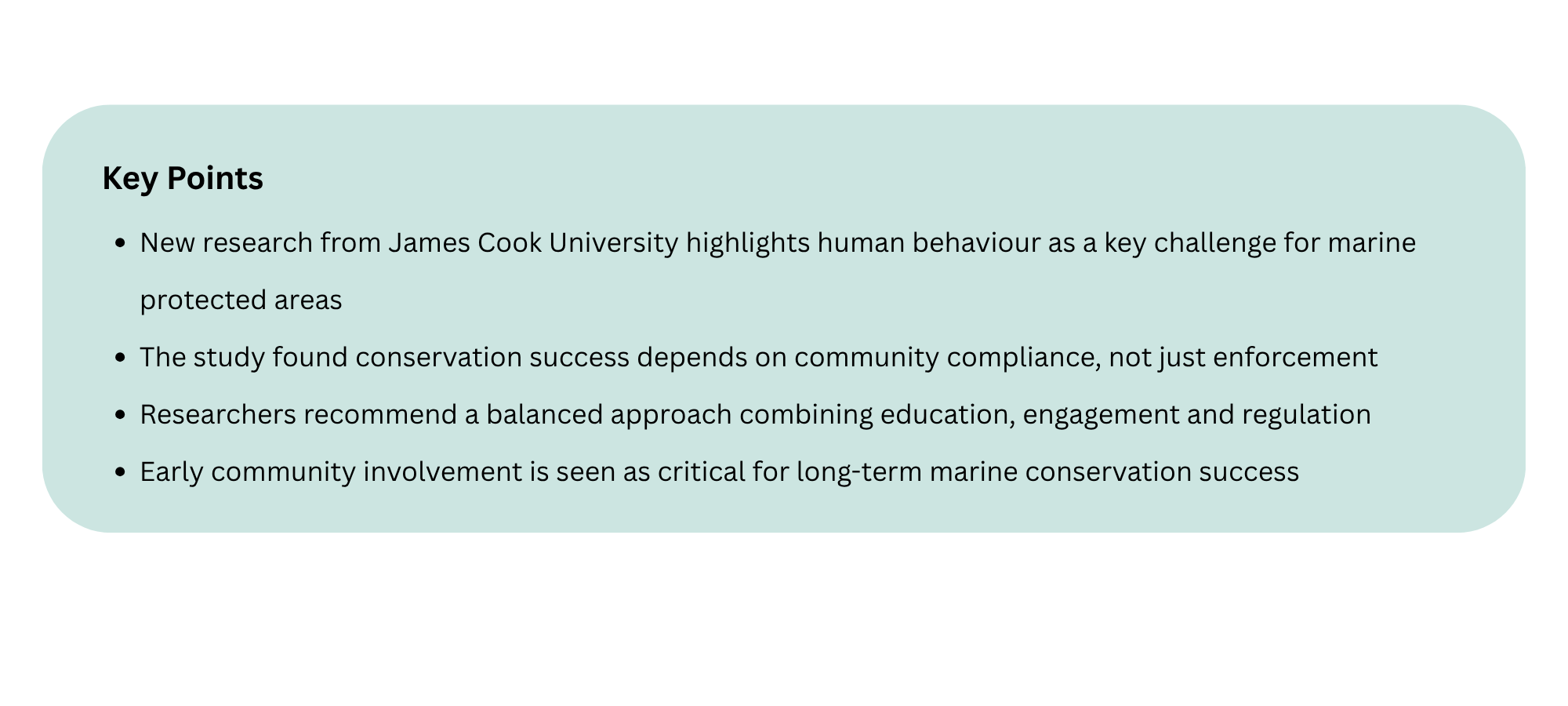
New research led by James Cook University is shining a light on what experts describe as the “Achilles’ heel” of marine protected areas (MPAs)—human behaviour.
While MPAs play a vital role in protecting ocean ecosystems, including coral reefs and seagrass habitats, the study found their success depends heavily on how well people comply with the rules designed to protect them.
Led by conservation scientist Brock Bergseth, the research brought together global experts to develop a new framework aimed at improving compliance.
“Globally, marine protected areas and other conservation programs are often impeded by the inability to successfully manage human behaviour,” Dr Bergseth said.
The study challenges the traditional reliance on enforcement and penalties, instead promoting a balanced “carrot and stick” approach that encourages voluntary compliance.
“While some enforcement may be necessary, it’s not a panacea for compliance,” Dr Bergseth said.
Researchers emphasised that early and ongoing engagement with communities is key to success, helping people feel a sense of ownership and fairness around regulations.
Senior researcher Jon Day said improving compliance systems would be critical for the future of marine conservation.
“Over the course of my career, I’ve seen what happens when compliance and enforcement are under-resourced or overlooked – to the detriment of effective MPAs,” he said.
“Reframing our global compliance system will better enable long-standing success of marine conservation initiatives, protecting ocean health now and far into the future.”
CAPTION: A new JCU-led study has shown that effective conservation relies heavily on compliance. Photo source: JCU
Publishers Indemnity. Any individual or entity that places advertising, supplies copy material, or submits editorial content to Life Publishing agrees and undertakes to ensure that all such material:- Does not infringe upon any copyright, trademark, or other intellectual property rights;- Is free from any content that could be considered defamatory, libelous, or slanderous;- Does not infringe upon any rights related to privacy or breach of confidence;- Contains no obscene, indecent, or otherwise unlawful material;- Complies fully with the Trade Practices Act and all other applicable laws, regulations, or statutes. Furthermore, by submitting or placing such material, these individuals or entities agree to indemnify and hold harmless the publisher, Life Publishing and Events Pty Ltd, and/or its agents from and against any and all investigations, claims, demands, liabilities, damages, costs, or judgments arising out of or in connection with the material provided. All material is believed to be accurate at the time of printing and remains the copyright of Life Publishing and Events Pty Ltd.
© 2026 Life Publishing Group Ltd.