Independently Owned, Locally Grown, Community Loved


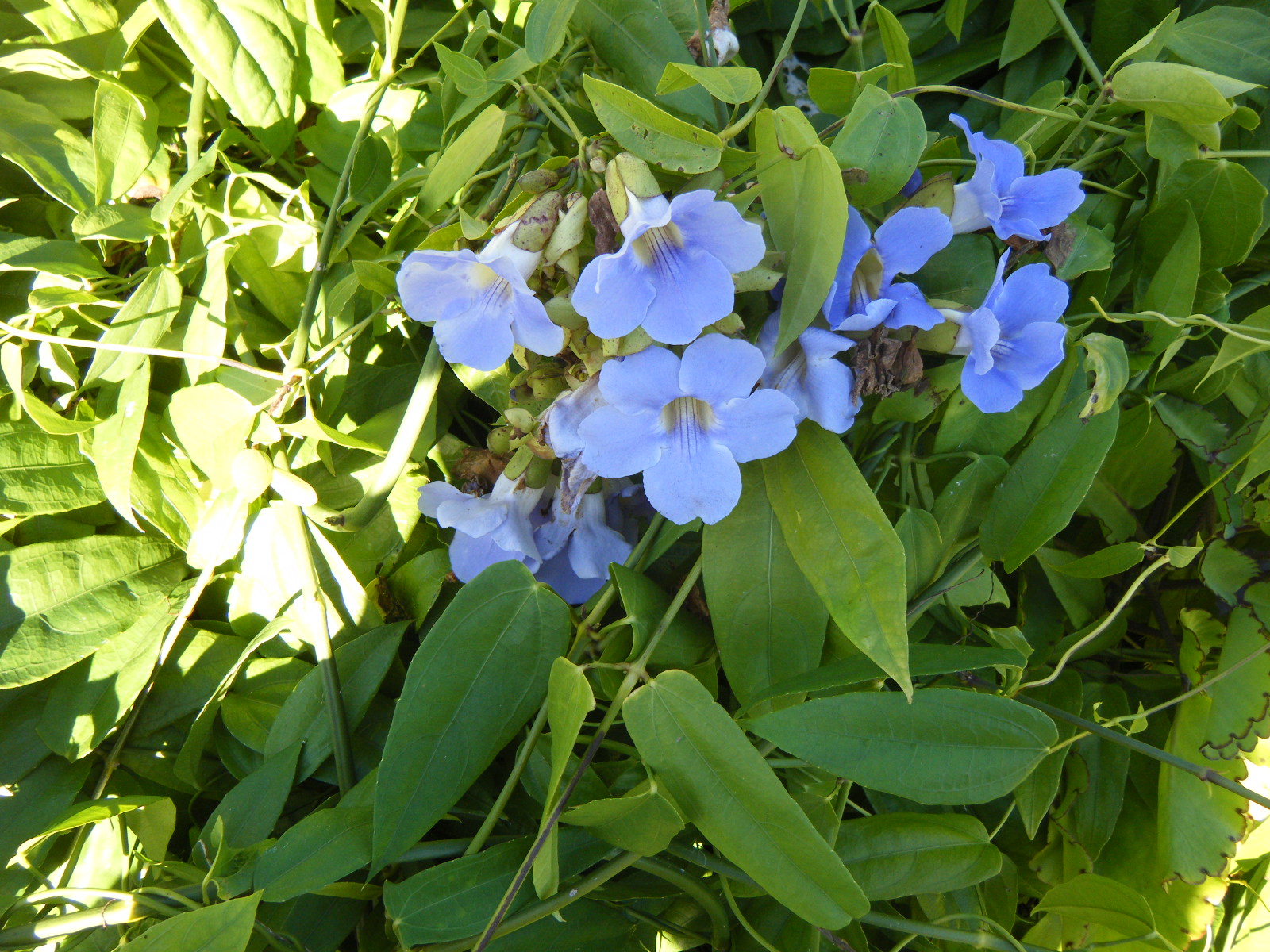
Thunbergia grandiflora (syn. Thunbergia laurifolia) Blue Thunbergia are a major threat to remnant vegetation.
Blue thunbergia was promoted and sold as an attractive garden plant and became widespread in Queensland gardens. This vigorous plant soon escaped into native bushland and began causing considerable environmental damage. The plant climbs and smothers native vegetation, with the weight of the vine often pulling down mature trees.
Large tubers degrade creek and riverbanks and make destruction of blue thunbergia difficult. In garden situations, it will also quickly spread, and the large tubers may cause damage to paths, fences and foundations. Other ornamental species of thunbergia (black-eyed Susan, scarlet clock vine, golden glory vine, lady’s slipper) are not as invasive, however, they are not recommended for planting because of their potential to spread into surrounding bush land.
Thunbergia species are a major threat to remnant vegetation in the wet tropics. Blue thunbergia is a restricted category 3 invasive plant under the Biosecurity Act 2014. It must not be given away, sold, or released into the environment.
Some specimens collected in Queensland were previously identified as Thunbergia laurifolia. These are now considered to be Thunbergia grandiflora. The Act requires everyone to take all reasonable and practical measures to minimise the biosecurity risks associated with invasive plants under their control.
This is called a general biosecurity obligation (GBO). At a local level, each local government must have a biosecurity plan that covers invasive plants in its area. This plan may include actions to be taken on blue thunbergia. Some of these actions may be required under local laws. Contact your local government for more information.
Blue thunbergia is a vigorous perennial twining vine climbing up to 15 m high if supported. Leaves are opposite along the stem up to 15 cm long, 10 cm wide and broad-based narrowing to a pointed tip.
The trumpet-shaped flowers have a short, broad tube, white on the outside, yellowish inside, which expands to five rounded, pale lavender-blue petals. The flowers are up to 8 cm long and 6−8 cm across.
The seed pod is inconspicuous, cone shaped, 3−5 cm long, with a rounded base. The seed is flat, up to 1 cm long and covered with brown scales.
The plant develops a very tuberous root system, some tubers being as large as 70 kg. The root system, when cut, persistently sprouts from its many dormant buds.
Blue thunbergia reproduces via seed. Seeds in pods are catapulted several meters when the pod splits. Blue thunbergia is also capable of regenerating from stem fragments or portions of the tuberous roots and vegetatively by stolons.
Blue thunbergia is spread by people for ornamental plantings and dispersal of root pieces along river banks during floods, or transport from infested sites with earth removed for fill or other soil use.
Infestations of blue thunbergia are patchy and are mostly scattered along coastal streams from the Tully River to the Daintree. Areas of acute infestation are the Mulgrave River, the Johnstone River and lower Mossman River.
Blue thunbergia was originally sought for its attractive lavender flowers, and spread primarily via the ornamental plant trade. Public awareness of this garden escapee, with its vigorous growth and alarming potential to spread, is increasing. Existing garden specimens should be destroyed.
Plant cuttings should not be dumped—this is a frequent source of new weed infestations. The origin of new top soil or fill should be checked as physical transportation of plant segments in soil or flood waters is a major method of spread.
The cutting of the vines at ground level will give a smothered tree a reprieve, but regeneration of the vine from tubers will soon occur.
Only small plants can be dug out, as established plants normally have extensive underground tubers. Spraying or injecting with herbicides is often the only option.
Herbicide treatment is often the only option available and provides fast and effective control. Good application technique should result in few non-target plants being destroyed.
Although very effective, one application by either overall spraying or injection rarely achieves 100% success. Ongoing monitoring and follow-up is needed.
For more information visit www.biosecurity.qld.gov.au

Blue Thunbergia escaping a garden and growing through a town. Photo credit: Queensland Government
Blue Thunbergia flowers and vines up close: Photo credit: Hinchinbrook Shire Council
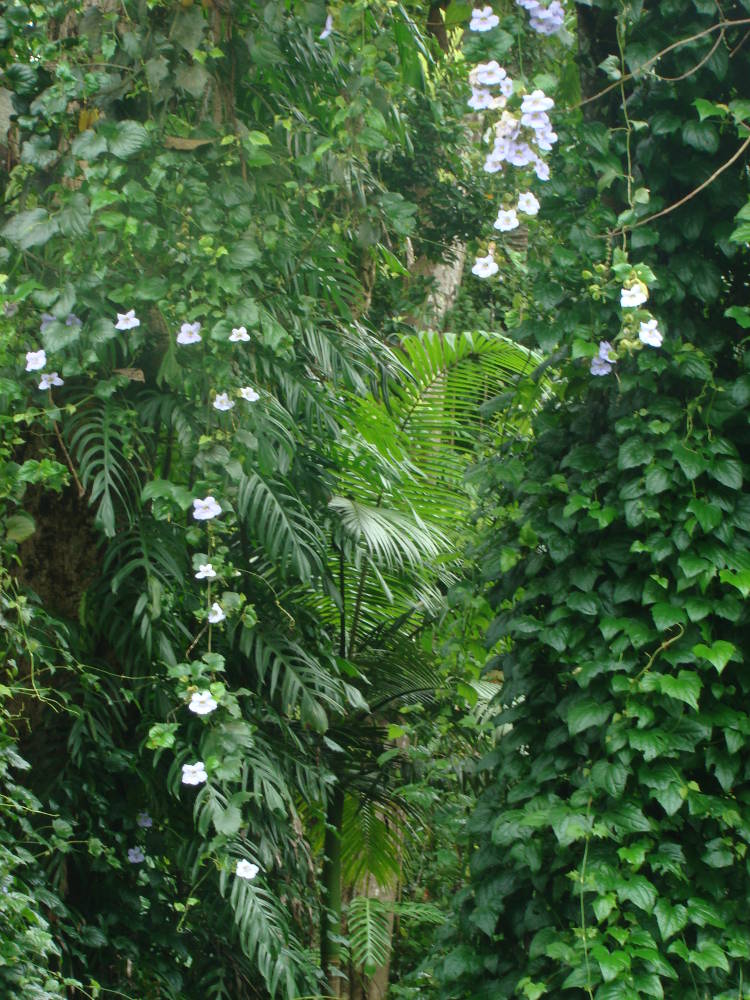
Blue Thunbergia smothering native vegetation along a creek bed. Photo credit: Queensland Government
Publishers Indemnity. Any individual or entity that places advertising, supplies copy material, or submits editorial content to Life Publishing agrees and undertakes to ensure that all such material:- Does not infringe upon any copyright, trademark, or other intellectual property rights;- Is free from any content that could be considered defamatory, libelous, or slanderous;- Does not infringe upon any rights related to privacy or breach of confidence;- Contains no obscene, indecent, or otherwise unlawful material;- Complies fully with the Trade Practices Act and all other applicable laws, regulations, or statutes. Furthermore, by submitting or placing such material, these individuals or entities agree to indemnify and hold harmless the publisher, Life Publishing and Events Pty Ltd, and/or its agents from and against any and all investigations, claims, demands, liabilities, damages, costs, or judgments arising out of or in connection with the material provided. All material is believed to be accurate at the time of printing and remains the copyright of Life Publishing and Events Pty Ltd.
© 2026 Life Publishing Group Ltd.