Independently Owned, Locally Grown, Community Loved

After months spent indoors and glued to screens, many children are showing signs of reduced physical and emotional wellbeing. Tanya Bird, Practice Manager at Naturally Kids, says, “We are increasingly seeing children who have had fewer opportunities for movement, exploration and social interaction in their everyday lives.”
Physically, this can show up as “reduced core strength, balance and coordination, as well as delays in motor development. As children are spending more time sitting, in their day both at school and at home we see the resultant impact on posture and overall physical confidence.” She explains, “We’re seeing more children who struggle with attention, emotional regulation and resilience. When children spend extended periods indoors and on screens, they miss out on the natural opportunities to practise problem-solving, risk-taking and social interaction that come with active play.”
The solution, Bird says, is outdoor play. “Outdoor play provides children with a rich environment that supports multiple areas of development at once. Nature encourages children to move in varied and unpredictable ways — climbing, balancing, running and exploring — which helps build strength, coordination and body awareness. It also stimulates sensory development, which is essential for children’s ability to regulate their emotions and focus on tasks.”
Bird highlights that outdoor activity can help children ‘reset’ after time spent indoors. “The open environment, natural light and freedom to explore allow children to reconnect with their bodies, their curiosity and their sense of independence.” Beyond physical benefits, time outside supports mental wellbeing and social skills. “Outdoor play offers children something that structured indoor environments often cannot — freedom to experiment, take manageable risks and solve problems independently. When children climb a tree, build something with sticks or work together to complete a task outdoors, they are developing confidence and resilience.”
Outdoor play also encourages collaboration. “Children negotiate rules, share ideas and practise teamwork without the pressure that can sometimes come with structured activities. From a mental health perspective, time outdoors is incredibly regulating for children. It helps reduce anxiety, improves mood, and supports attention and concentration. These benefits are particularly important for neurodiverse children who may experience sensory or emotional regulation challenges.”
For parents unsure how to get their children outside, Bird recommends starting small and keeping it fun. “Make it part of everyday life rather than something that feels like another task. Children learn from watching adults model the behaviour. Some simple strategies include visiting local parks or beaches for short, regular play sessions, encouraging unstructured play outdoors, creating ‘nature challenges’ like collecting leaves or spotting wildlife, replacing some screen time with family walks or backyard play, and letting children lead the activity rather than directing how they should play.”
Bird emphasises consistency with, “Even small amounts of outdoor play each day can have a big impact on a child’s physical and emotional wellbeing. Children are naturally curious. Often, once they are outside and given time to explore, the motivation to play emerges quickly.”
Naturally Kids integrates outdoor environments into therapy programs as well. “Our therapists regularly work with children in community settings such as parks, schools and other natural environments, allowing therapy to occur in spaces where children feel comfortable and motivated to engage. We also offer nature-based occupational therapy groups such as Joey’s Mob, where small groups of children participate in therapist-led outdoor activities, including building swings, crafting and exploring nature. Programs such as Sense Rugby provide structured movement experiences that support gross motor skills, balance, sensory processing, teamwork and social interaction in a fun and supportive environment.”
Bird concludes, “A child may benefit from more structured support when challenges with coordination, attention, emotional regulation, social participation or sensory processing begin to affect everyday activities such as school, play or friendships. Occupational therapy can help children build these skills through play-based approaches that are engaging, meaningful and tailored to each child’s strengths.”
Encouraging children to spend time outdoors doesn’t have to be complicated. By creating opportunities for exploration, movement, and connection with nature, families can help children build physical strength, confidence, resilience, and a lifelong love of active play. In a world increasingly dominated by screens, the simple joy of outdoor adventure may be exactly what today’s children need to thrive.
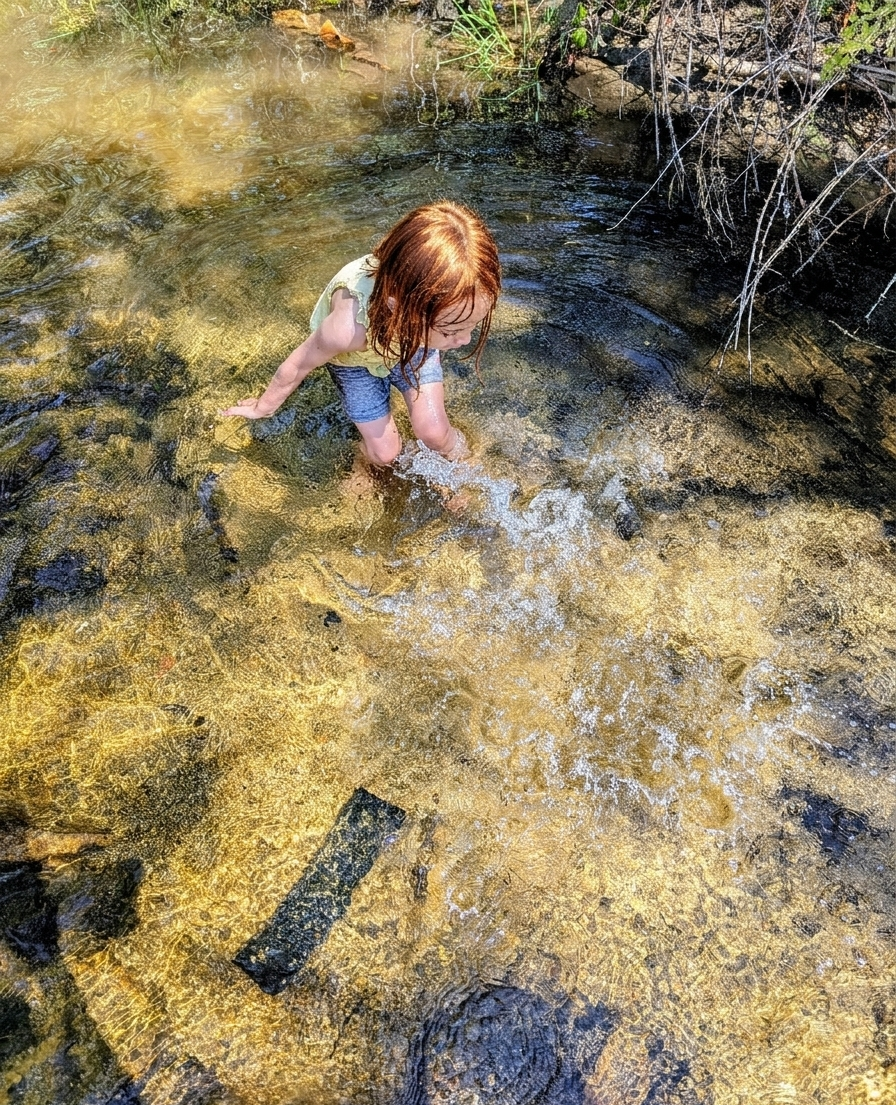
Caption: Activities as simple as splashing water about in a creek can build body awareness and coordination. Photo credit: Victoria Velton

Caption: Building a bark and stick hut is a fun way to encourage creativity and natural connections. Photo credit: Victoria Velton
Publishers Indemnity. Any individual or entity that places advertising, supplies copy material, or submits editorial content to Life Publishing agrees and undertakes to ensure that all such material:- Does not infringe upon any copyright, trademark, or other intellectual property rights;- Is free from any content that could be considered defamatory, libelous, or slanderous;- Does not infringe upon any rights related to privacy or breach of confidence;- Contains no obscene, indecent, or otherwise unlawful material;- Complies fully with the Trade Practices Act and all other applicable laws, regulations, or statutes. Furthermore, by submitting or placing such material, these individuals or entities agree to indemnify and hold harmless the publisher, Life Publishing and Events Pty Ltd, and/or its agents from and against any and all investigations, claims, demands, liabilities, damages, costs, or judgments arising out of or in connection with the material provided. All material is believed to be accurate at the time of printing and remains the copyright of Life Publishing and Events Pty Ltd.
© 2026 Life Publishing Group Ltd.