Independently Owned, Locally Grown, Community Loved


By Dr Bianka Vidonja Balanzategui
Do you know that Sir Henry Alexander Wickham, father of the rubber industry, once lived in the Herbert River Valley? He made the automobile industry possible when he removed rubber plant seeds from Brazil for the Royal Botanical Gardens at Kew.
No relation to George Wickham, Henry Wickham was born in London in 1846. He spent much of his adult life as an explorer and pioneer planter living in diverse tropical locations, experimenting with many crops.
After being refused employment at Kew to disperse rubber seedlings for the global rubber industry, he abandoned his plantation in Brazil, arriving in Townsville on 22 January 1877 with his wife, Violet Carter. They travelled straight to the lower Herbert carrying with them young tobacco plants and sapling coffee trees.
There was a strong settler demand for tobacco and snuff that was not being met by imports, while the indentured Melanesian workers, as well as the Indigenous peoples, preferred the tobacco introduced by Europeans to the native variety.
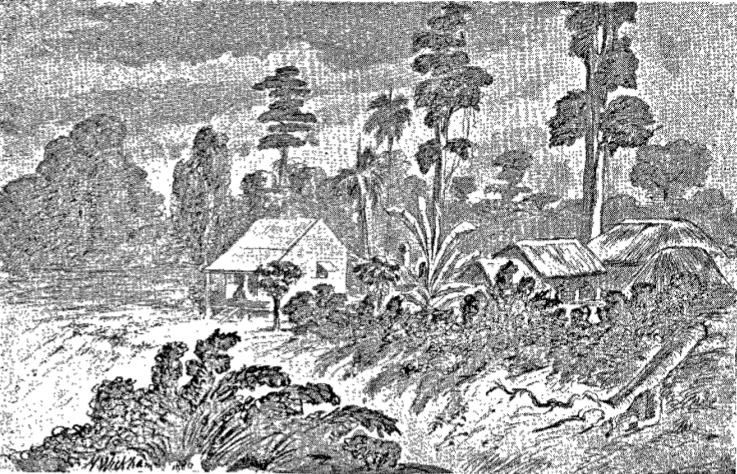
Refashioning his past, Wickham described himself as an American tobacco expert, showing local shopkeepers samples of tobacco he claimed to have grown and cured in Brazil. He immediately started taking up land, calling his holdings Maragen.
In 1876, John Eustace Hammick moved to the Herbert and took up a selection, calling it Coolamatong. Joining Wickham in a business partnership, they put in experimental plantings of tobacco.
Wickham distributed samples of their tobacco far and wide and exhibited at the National Agricultural and Industrial Association’s exhibition held in Brisbane in 1879. On that occasion, they received second place for their tobacco. They began to expand their range responding to market taste. In 1881, Messrs. Gaujard and Elson, Brisbane, became their marketers. Well-cured samples were declared ‘par excellence’ and locals thought the tobacco was ‘well manufactured’.
While Hammick and Wickham travelled away promoting their product, Violet was left for weeks on end to face growing and curing tobacco in an unfamiliar environment alone. Her diary reveals her to be a courageous woman with a good sense of humour.
For nine years, Wickham and Violet persevered. Nevertheless, despite attempting to pander to consumer tastes, demand fell and their efforts faltered on climatic conditions, taste and Wickham’s poor business decision to sell tobacco that had not been cured long enough.
Hammick broke the partnership leaving Wickham in debt. The Wickhams continued farming for another 18 months but meanwhile, Wickham hatched a plan in 1884 to survey Maragen for sale as the Mount Maragen Town Selection. No township eventuated and most of the surveyed town blocks were absorbed as cane land. Practically penniless, Violet and Wickham sailed for England in early 1886.
Ever the adventurer, Wickham moved on to further adventures in other tropical plantation areas, while today, on the Herbert, Mount Maragen remains as a distant echo of Sir Henry Alexander Wickham.
Publishers Indemnity. Any individual or entity that places advertising, supplies copy material, or submits editorial content to Life Publishing agrees and undertakes to ensure that all such material:- Does not infringe upon any copyright, trademark, or other intellectual property rights;- Is free from any content that could be considered defamatory, libelous, or slanderous;- Does not infringe upon any rights related to privacy or breach of confidence;- Contains no obscene, indecent, or otherwise unlawful material;- Complies fully with the Trade Practices Act and all other applicable laws, regulations, or statutes. Furthermore, by submitting or placing such material, these individuals or entities agree to indemnify and hold harmless the publisher, Life Publishing and Events Pty Ltd, and/or its agents from and against any and all investigations, claims, demands, liabilities, damages, costs, or judgments arising out of or in connection with the material provided. All material is believed to be accurate at the time of printing and remains the copyright of Life Publishing and Events Pty Ltd.
© 2026 Life Publishing Group Ltd.