Independently Owned, Locally Grown, Community Loved

By Dr Bianka Vidonja Balanzategui
If only the mango trees lining the main street of Halifax could talk! Mango trees (Mangifera indica) were planted by the European pioneers of the Herbert River district for their fruit and shade. Farm gardens and riverbanks evidence their proliferation.
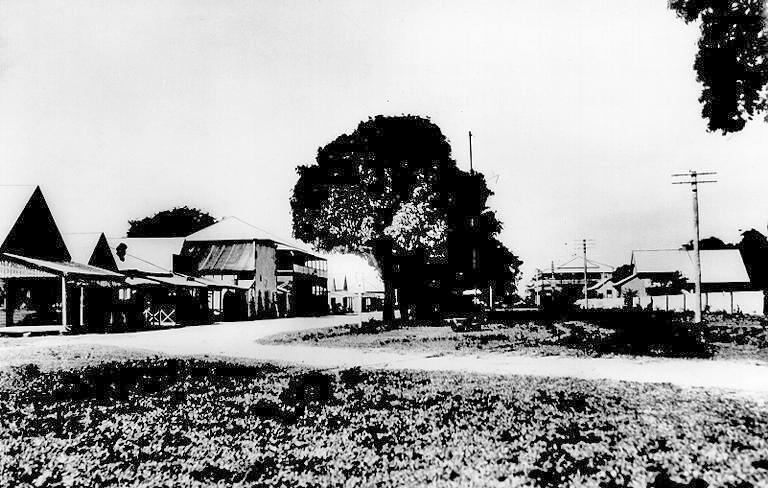
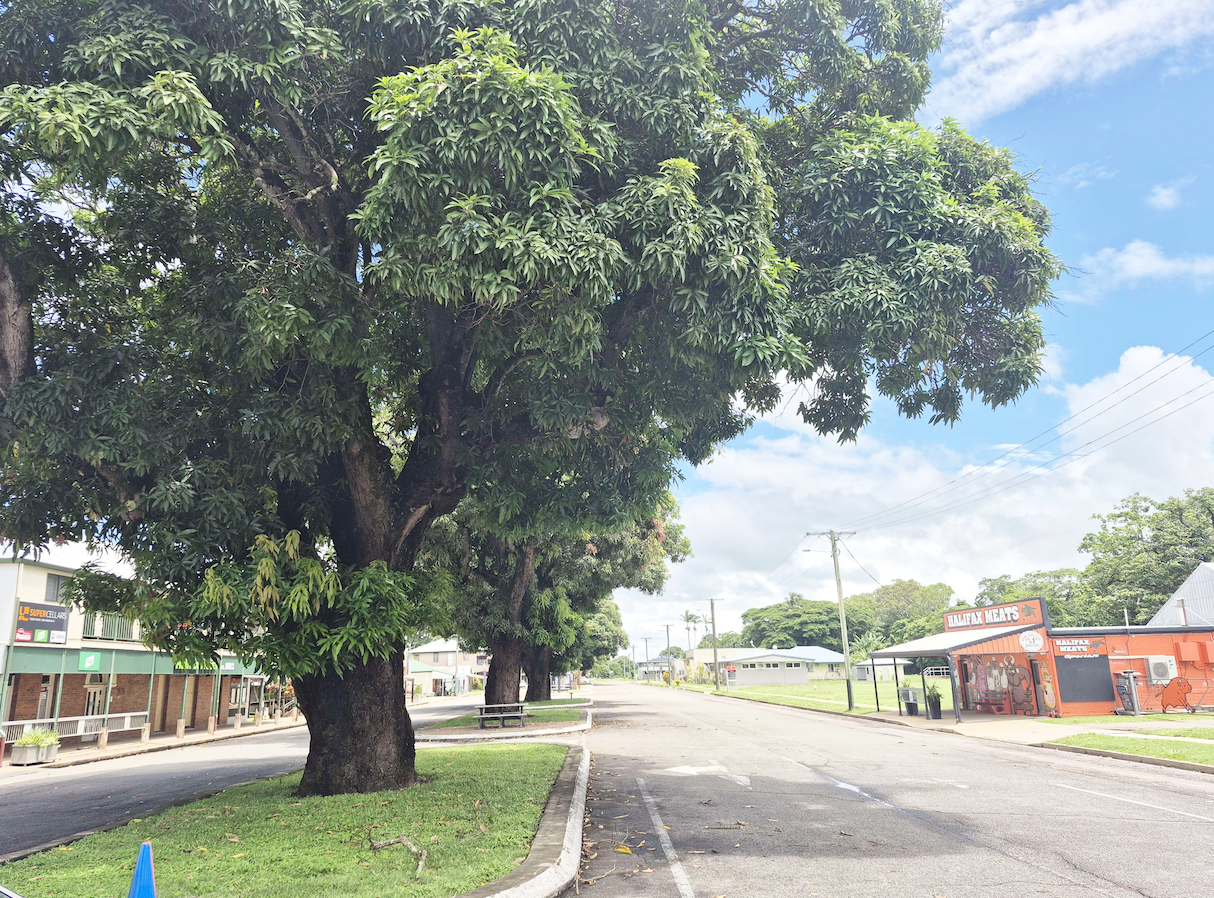
Lining the centre of the little township of Halifax is a stand of magnificent trees, including mango trees (originally numbering eight) planted by the six Herbert River Farmers Association founding members – Harald Hoffensetz, August Anderssen, Arthur W. Carr, Niels C. Rosendahl, John Alm and Francis Herron – in an effort to beautify the township. Today, listed on the Queensland Heritage Register because of their significant heritage value, they stand as an enduring physical legacy of those men’s investment in their adopted home and the sugar industry of the Herbert River Valley. The community is protective of the trees and has resisted past proposals for their removal.
Over time the mango trees became a gathering place and eavesdroppers of gossip, tall tales and true for Macrossan Street provided a regular meeting place for new immigrants. Older members of the Italian community maintained this tradition over decades, sweeping the surrounds of leaves and mangoes before settling down on the bench under one particular tree for gossip and lively discussions of world events and of course the state of the sugar industry. Such gathering places under trees have come to be known as Trees of Knowledge or Seats of Knowledge and the practice can be traced back to the Roman Forum.
In time, in Halifax, the petrol station replaced the mango trees as a gathering place. Former proprietor of the petrol station, Andrew Lancini recalls a seat outside the station where elderly men would similarly gather to chat and solve the problems of the world. The seat was euphemistically called the ‘Departure Lounge’ for with the passing of the years fewer gathered.
Inghamites recall a similar Tree of Knowledge across from the East Ingham hotel.
But the Tree of Knowledge was not exclusive to the gathering of retired Italian farmers. For example, in Townsville the Tree of Knowledge (actually three trees planted in the 1890s and originally called the Shade Trees), on the corner of Flinders and Denham Streets was a gathering point for the opening rallies of all political campaigns – municipal, state and federal. There candidates would conduct “soapbox debates”. The last of those trees was removed in 1972.
Locals of the towns dotting the coast of north Queensland can identify such former Trees or Seats of Knowledge with some nostalgia. But recent investigation reveals the tradition lives on in places like Tully with its Seat of Knowledge and Kurrimine Beach with its popular Table of Knowledge.
This tradition had roots in the Italian communities that were established through migration to the region with the tradition possibly tracing back to the Roman forum. As the design of Italian piazzas reflect that forum construction landscape. being the main focal point of the village for everyone to gather.
Although many of those who originally gathered at certain 'places of knowledge' had passed, and the tradition had declined in some areas, there was a resurgence in other areas as new generations are picking up versions of that tradition and perhaps gathering outside a cafe to chat for a few hours.
Whether they take the form of benches, tables, or even a well-shaded mango tree, these spaces play an important role in the shared heritage of regional communities. They are places where stories are exchanged, memories are made, and a bit of local gossip flows freely, all adding to the knowledge gained and the friendships strengthened along the way.
Caption for Mango tree OLD: Mango trees, Macrossan Street Halifax, 1897. Image sourced: Hinchinbrook Shire Library Photographic collection.
Caption Mango tree 2025: Mango trees, Macrossan Street Halifax, 2026. Photo credit: Victoria Velton
Publishers Indemnity. Any individual or entity that places advertising, supplies copy material, or submits editorial content to Life Publishing agrees and undertakes to ensure that all such material:- Does not infringe upon any copyright, trademark, or other intellectual property rights;- Is free from any content that could be considered defamatory, libelous, or slanderous;- Does not infringe upon any rights related to privacy or breach of confidence;- Contains no obscene, indecent, or otherwise unlawful material;- Complies fully with the Trade Practices Act and all other applicable laws, regulations, or statutes. Furthermore, by submitting or placing such material, these individuals or entities agree to indemnify and hold harmless the publisher, Life Publishing and Events Pty Ltd, and/or its agents from and against any and all investigations, claims, demands, liabilities, damages, costs, or judgments arising out of or in connection with the material provided. All material is believed to be accurate at the time of printing and remains the copyright of Life Publishing and Events Pty Ltd.
© 2026 Life Publishing Group Ltd.