Independently Owned, Locally Grown, Community Loved


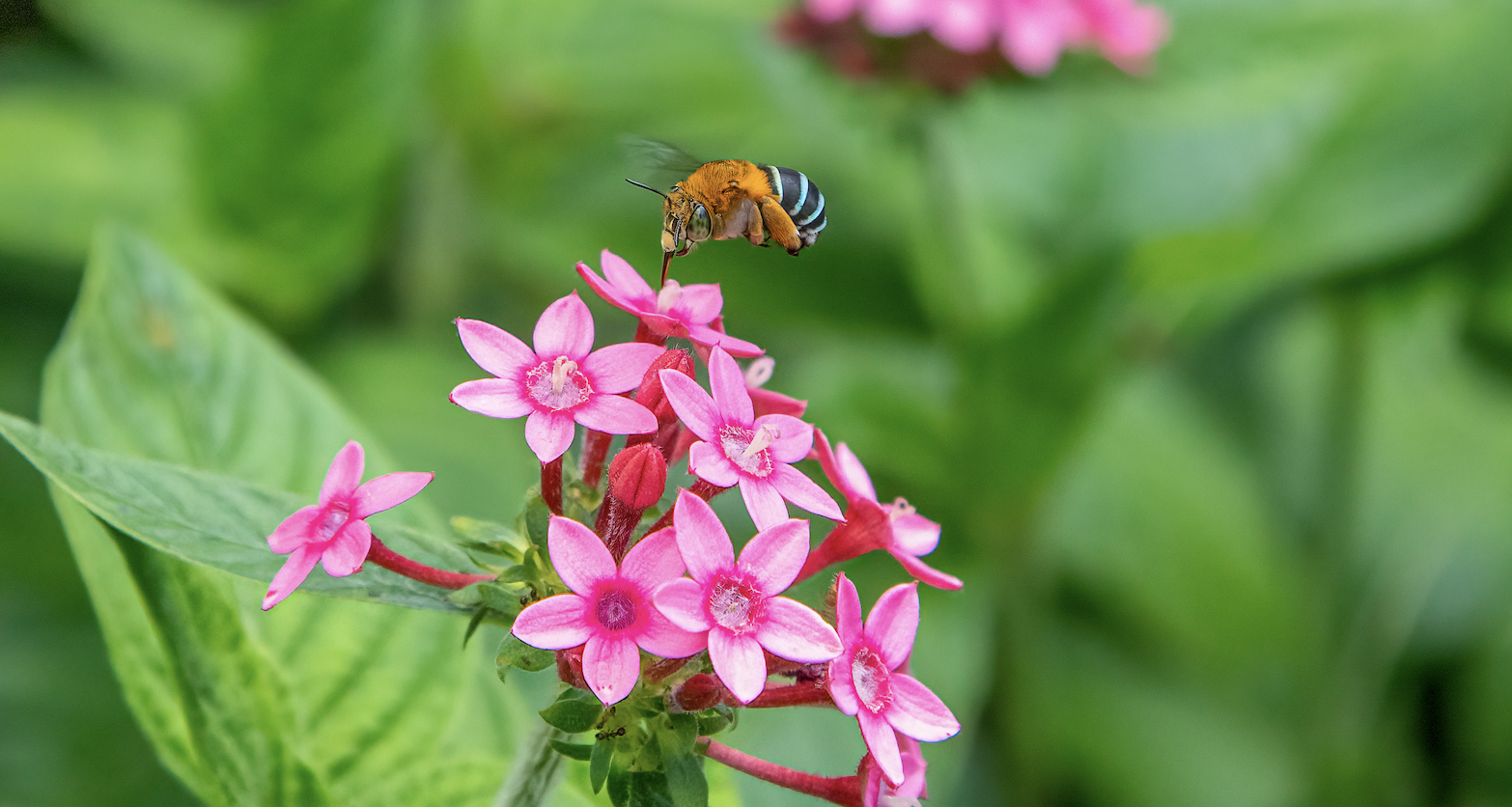
Science in the Pub at Shanti Café on 12th November coincides with Australian Pollinator Week. Image credit: Jane Frost
Did you know that the Cassowary Coast is one of Australia's biodiversity hotspots for native bees? Or that some of our beautiful local bees are bright blue, while others happily make their homes in the walls of our houses without causing any damage?
These fascinating little creatures will take centre stage at Science in the Pub at Shanti Café, Mission Beach, this Thursday 12th November, with local bee enthusiasts Jane Frost and Kylie Azzopardi sharing their knowledge, photographs and passion for our native pollinators.
Timed to coincide with Australian Pollinator Week, the evening will explore the extraordinary diversity of native bees, their importance to our environment and agriculture, and how we can encourage them into our gardens.
Jane, a teacher, nature photographer and chair of the Australian Native Bee Association's Cassowary Coast branch, first became fascinated by bees while photographing insects in her garden.
"I'm just a bit of a nature nerd," she said. "I tend to wander around my garden with my camera and I like to identify anything I photograph."
Her curiosity developed into a passion for macro photography, capturing remarkable images of native bees, including several stunning blue species.
"Fifteen years ago I had no idea that we had bees that were blue. And now I've found quite a few different blue species."
Kylie, a founding member of the local association branch, has spent many years working as a science teacher and laboratory technician while also running a cane farm with her husband. She will explain the differences between native bees and European honey bees, and how keeping native bees can help support local biodiversity and agriculture.
With the arrival of varroa mite threatening European honey bees, Jane says there's growing interest in the role our native pollinators can play. She also hopes to dispel misconceptions about stingless bees nesting in houses, explaining that their hives cause no structural damage.Guests at this special event will have the opportunity to peer inside specially designed observation hives.
Whether you're a gardener, nature lover or simply curious about what's buzzing around your backyard, this promises to be a fascinating evening.
Varroa mite – a growing threat to our honey bees
What can we do? Protect native bee habitats and grow flowering plants to encourage pollinators into our gardens.
Publishers Indemnity. Any individual or entity that places advertising, supplies copy material, or submits editorial content to Life Publishing agrees and undertakes to ensure that all such material:- Does not infringe upon any copyright, trademark, or other intellectual property rights;- Is free from any content that could be considered defamatory, libelous, or slanderous;- Does not infringe upon any rights related to privacy or breach of confidence;- Contains no obscene, indecent, or otherwise unlawful material;- Complies fully with the Trade Practices Act and all other applicable laws, regulations, or statutes. Furthermore, by submitting or placing such material, these individuals or entities agree to indemnify and hold harmless the publisher, Life Publishing and Events Pty Ltd, and/or its agents from and against any and all investigations, claims, demands, liabilities, damages, costs, or judgments arising out of or in connection with the material provided. All material is believed to be accurate at the time of printing and remains the copyright of Life Publishing and Events Pty Ltd.
© 2026 Life Publishing Group Ltd.