Independently Owned, Locally Grown, Community Loved


This year CANEGROWERS celebrates its 100-year milestone. In 1901 and the introduction of the ‘White Australia Policy’ it was hard to envisage what the industry would look like after the withdrawal of indentured labour. Farmers and millers danced around each other trying to work out the best way for the industry to be represented.
The report of the 1912 Royal Commission into the Australian Sugar Industry indicated a need for government control of raw sugar prices. In 1915 the Queensland government enacted legislation to achieve that control: the Sugar Acquisition Act which allowed the Queensland government to acquire all sugar manufactured in Queensland and sell it on to the Commonwealth Government at cost. And the Regulation of Sugar Cane Prices Act to ensure a fair division of raw sugar returns between millers and growers.
Lack of unity across the agricultural community prompted the Queensland government to embark on a comprehensive reorganisation of farm industries. It enacted the Primary Producers’ Organisation Act of 1922 which legislated for the formation of commodity industry bodies with power to compel all persons in that industry to become members and pay levies.
The Primary Producers’ Organisation and Marketing Act of 1926 replaced the former Act making special provisions for the sugar industry with compulsory membership and a compulsory farmer levy paid to the Queensland Cand Growers Association (QCGA). It provided for mill suppliers committees, district cane growers’ executives, and the Queensland Cane Growers’ Council (QCGC) which became the governing body of the Queensland Cane Growers’ Association (QCGA).
The QCGC was made up of two cane grower representatives from each of the mill areas. The local District Executive of the QCGA was formed in 1926. HRFL members A.L. Musgrave was elected as the first secretary of district executive, and George Geeson as first president while W. M. Tooth, former president of the HRFL became the first Herbert River representative on the QCGC.
The steps that brought this district executive into existence are unknown. Annette Veree Ford who wrote a thesis on the QCGA Herbert River district branch found that there were no records kept until 1933. What is known is that the district executive inherited the HRFL’s active membership and readymade area branches and invited the district executive to hold meetings in the HRFL building and rent office space in which to carry out administrative tasks.
The district executive’s roles duplicated those of the HRFL: conducting large district meetings; negotiating with CSR on cane price and supervising labour arrangements; and the political and social community role of petitioning state or federal government representatives on both industry and wider community needs. To those roles was added those pertaining to production and marketing.
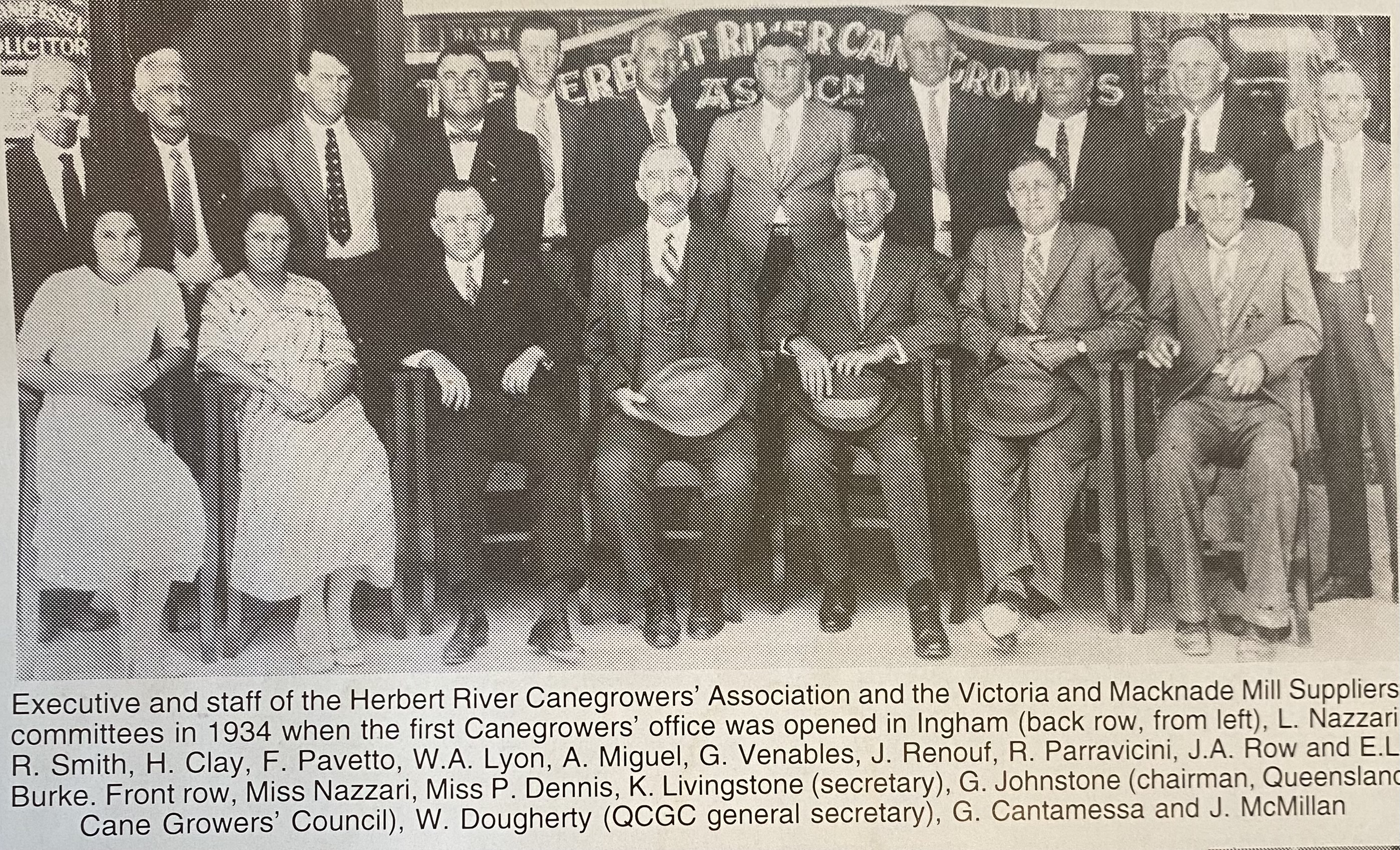
In February 1932 the Herbert River Cane Growers Association (HRCGA) was formed. Prominent member of the HRFL T.J. McMillan, was elected as the first president. When the HRCGA decided that its “status and dignity” warranted its own building it gained a perpetual lease of an allotment on the opposite side of Lannercost Street, defiantly facing the HRFL building. The new farmers’ building was opened in 1934.

Image 1: Caption: Farmers’ building opened in 1934. Image source: State Library of Queensland. Image number: 96364
Image 2: Caption: The Canecutters: A Tribute to the Sugar Field Workers of Herbert Valley. Image supplied
Publishers Indemnity. Any individual or entity that places advertising, supplies copy material, or submits editorial content to Life Publishing agrees and undertakes to ensure that all such material:- Does not infringe upon any copyright, trademark, or other intellectual property rights;- Is free from any content that could be considered defamatory, libelous, or slanderous;- Does not infringe upon any rights related to privacy or breach of confidence;- Contains no obscene, indecent, or otherwise unlawful material;- Complies fully with the Trade Practices Act and all other applicable laws, regulations, or statutes. Furthermore, by submitting or placing such material, these individuals or entities agree to indemnify and hold harmless the publisher, Life Publishing and Events Pty Ltd, and/or its agents from and against any and all investigations, claims, demands, liabilities, damages, costs, or judgments arising out of or in connection with the material provided. All material is believed to be accurate at the time of printing and remains the copyright of Life Publishing and Events Pty Ltd.
© 2026 Life Publishing Group Ltd.